

For decades, the heart of a personal computer has been defined by a fierce rivalry: Advanced Micro Devices (AMD) versus Intel. This competition, far from being a simple branding battle, is the driving force behind the rapid innovation in processing power that consumers enjoy today. Choosing between an AMD Ryzen and an Intel Core CPU is no longer a matter of picking the default option; it’s a strategic decision that hinges on your specific needs, budget, and vision for your PC. This guide dives into the architectural philosophies, performance nuances, and ecosystem considerations that define the current landscape of this silicon duel.
The Architectural Divide: Chiplets vs. Monoliths
The most fundamental difference between modern AMD and Intel CPUs lies in their physical design philosophy, which directly impacts performance, cost, and efficiency.
AMD, since the launch of its groundbreaking Zen architecture, has championed a “chiplet” design. In this approach, the CPU is not a single, monolithic slab of silicon. Instead, it comprises several smaller dies: “Core Complex Dies” (CCDs) containing the CPU cores and cache, and a central “I/O Die” that handles communication with memory, storage, and other system components. This modular method is more cost-effective to manufacture, as smaller dies have a higher yield (fewer defects). It also allows AMD to scale core counts dramatically—its mainstream Ryzen 9 CPUs offer up to 16 cores, while its Threadripper and Epyc lines push into the 64+ core territory for workstations and servers.
Intel, until its recent 12th, 13th, and 14th Gen Core series, adhered to a monolithic design—where all cores, cache, and the memory controller are on a single die. This can offer lower latency for communication between cores. With its newer generations, Intel has adopted a hybrid architecture it calls “Performance-core (P-core) and Efficiency-core (E-core),” but it still utilizes a more monolithic-like approach compared to AMD’s discrete chiplets. Intel’s strength here has traditionally been in maximizing the performance of individual cores (single-threaded performance), a key metric for many games and everyday tasks.
Performance Paradigms: Gaming, Multitasking, and Creativity
The architectural choices lead to distinct performance profiles, though the gap has narrowed significantly.
- Gaming: For years, Intel held the undisputed gaming crown, thanks to its superior single-threaded speed and clock frequencies. However, with the Ryzen 5000 series and now the Ryzen 7000/8000 series, AMD has largely closed this gap. Today, the competition is razor-thin. At the high-end (e.g., Core i9-14900K vs. Ryzen 9 7950X3D), the difference in average frame rates is often within a few percentage points, varying by title. AMD’s unique weapon is its 3D V-Cache technology, which stacks a massive pool of L3 cache directly on the chip. In games that love cache (like many simulation and MMO titles), these X3D CPUs can deliver a commanding lead.
- Multithreaded & Content Creation Workloads: This is where AMD’s core-count advantage traditionally shone. Applications like video editing (Adobe Premiere, DaVinci Resolve), 3D rendering (Blender, V-Ray), and scientific computing can leverage all available cores and threads. More cores mean faster rendering and encoding times. Intel has fought back fiercely with its hybrid architecture, using E-cores to handle background tasks and multi-threaded loads, making its high-end Core i7 and i9 chips extremely competitive. For a professional whose time is money, the choice often comes down to specific software optimization and the balance between multi-core throughput and single-core responsiveness.
- Power Efficiency & Heat: This is a critical, often overlooked differentiator. AMD’s chiplet design and its partnership with TSMC for manufacturing have given it a notable efficiency advantage. A Ryzen CPU often delivers comparable performance to its Intel counterpart while consuming significantly less power and producing less heat. For example, a Ryzen 7 7700X can match or beat a Core i7-13700K in many tasks while having a much lower Thermal Design Power (TDP). This translates to quieter cooling solutions, less strain on the power supply, and lower electricity costs over time. Intel’s current top chips, while incredibly powerful, are known to push power limits to achieve their peak performance.
Platform & Ecosystem Considerations
Your CPU choice locks you into a specific motherboard socket and platform, which has long-term implications.
- Socket Longevity & Upgrade Path: AMD has earned immense user goodwill with its AM4 socket, which supported four generations of CPUs (Ryzen 1000 to 5000). This allowed users to upgrade their CPU without replacing the motherboard. Its new AM5 platform (for Ryzen 7000 and beyond) represents a fresh start with DDR5 memory and PCIe 5.0 support, and AMD has committed to supporting it through at least 2025. Intel, conversely, typically changes its socket every two generations. Moving from 12th to 13th or 14th Gen was possible, but the upcoming 15th Gen (Arrow Lake) will require a new motherboard. This makes AMD platforms potentially more future-proof.
- Integrated Graphics: This is no longer an afterthought. Both companies include capable integrated graphics (iGPUs) on most of their non-desktop-focused CPUs. Intel’s Iris Xe graphics have been competent for basic use. However, AMD’s Radeon iGPUs in its non-X Ryzen 7000 series (G-series on AM4, standard on many AM5 chips) are generally more powerful, offering playable frame rates in many esports titles. A significant new player is AMD’s Ryzen 8000G series, which packs the most powerful desktop iGPU ever seen, blurring the line between integrated and discrete graphics for budget gamers.
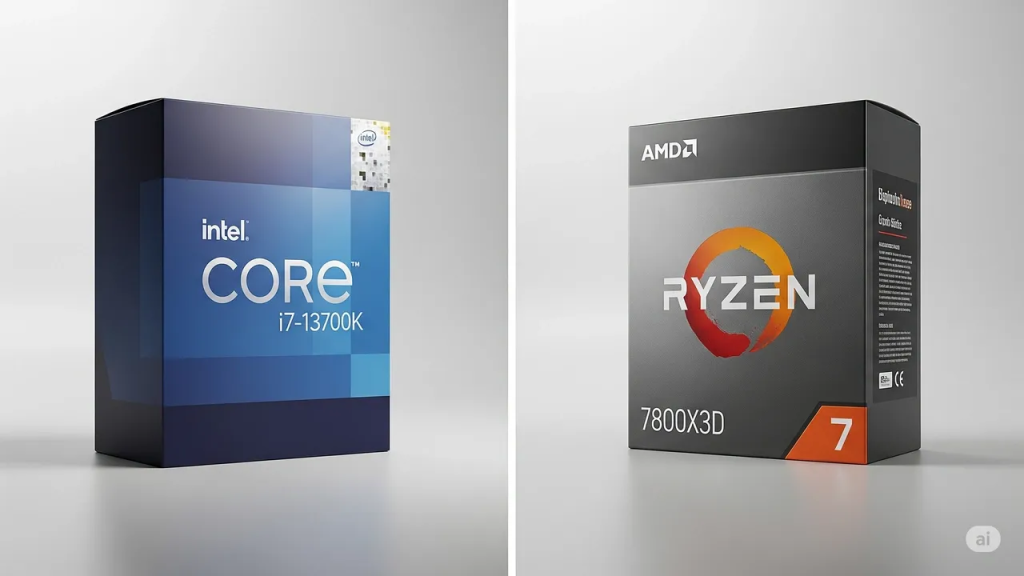
The Verdict: Which CPU is Right for You?
- Choose AMD Ryzen if: You prioritize power efficiency and lower thermals; you want a clear upgrade path on the AM5 platform; your workload heavily benefits from high core counts (rendering, coding, VMs); or you’re a gamer eyeing the exceptional performance of the X3D chips in cache-sensitive titles. It’s also often the king of value in the mid-range (Ryzen 5/Ryzen 7).
- Choose Intel Core if: You seek the absolute peak in single-threaded and gaming performance, particularly when paired with a high-end GPU; you use applications that are historically optimized for Intel (some professional creative suites); or you want the flexibility of its hybrid architecture to handle a mix of heavy gaming and background multitasking. The platform also offers more PCIe lanes natively in some segments.
Conclusion: A Golden Age for Consumers
We are in a golden age of CPU competition. The AMD vs. Intel battle is no longer a one-sided affair but a dynamic, back-and-forth struggle that forces both companies to innovate aggressively. There is no singular “best” CPU, only the best CPU for you. The winner in this rivalry isn’t AMD or Intel—it’s the consumer, who gets more performance, more features, and more value with every passing generation. The key is to look beyond the brand logo, understand the architectural strengths, and align them with the demands of your specific tasks, budget, and vision for your PC.