


From the predictable patrols of Pac-Man’s ghosts to the scripted dialogues of epic RPGs, video games have long relied on carefully crafted illusions to simulate a living world. For decades, game design was an exercise in meticulous scripting—every enemy encounter, every branching narrative, every citizen’s daily routine was painstakingly hand-coded by developers. Today, that paradigm is undergoing a seismic shift. Artificial intelligence, evolving from a rudimentary tool into a sophisticated collaborator, is no longer just powering enemies; it is fundamentally transforming how games are created, played, and experienced, pushing the medium toward unprecedented horizons of dynamism and personalization.
Beyond Bullet Sponges: The Revolution in Gameplay and Behavior
The most immediate impact for players is felt in the virtual entities they interact with. Traditional AI used finite state machines (e.g., “patrol,” “attack,” “flee”) resulting in predictable, exploitable behaviors. Modern AI, particularly machine learning and neural networks, is creating Non-Playable Characters (NPCs) with startling autonomy and adaptability.
Games like F.E.A.R. (2005) pioneered squad-based AI that used environmental cover and communication, but today’s experiments go much further. Through techniques like reinforcement learning, AI agents can now learn directly from their environment. They don’t just follow paths; they create strategies, adapt to the player’s unique tactics, and exhibit behaviors that feel less like programmed routines and more like organic reactions. Imagine an enemy that remembers your favored ambush spot and pre-emptively flanks it next time, or a wild animal in a survival game that develops unique hunting patterns based on its ecosystem. This creates a profound shift from challenge-by-design to challenge-by-emergence, where no two playthroughs present identical obstacles, demanding genuine skill and adaptation from the player.
The Living World: Procedural Generation Gets a Brain
Procedural generation is not new—the endless dungeons of Rogue are a testament to that. However, classic procedural algorithms often created vast but repetitive or nonsensical landscapes. AI is injecting creativity and coherence into this process. Tools like neural networks can now be trained on vast datasets of human-designed content—be it fantasy landscapes, dungeon layouts, or jazz melodies—and then generate new, stylistically consistent content that feels handcrafted.
This is exemplified in titles like AI Dungeon, which uses large language models to generate limitless, coherent narrative scenarios from player input. On a grander scale, imagine a role-playing game where every quest, piece of lore, and unique village is generated on the fly, tailored to your character’s backstory and actions, ensuring a truly unique narrative journey for every player. The dream of a boundless, ever-fresh game world is inching closer to reality, moving beyond simple terrain generation to the creation of meaningful, contextual content.
The Personalized Playground: Adaptive Narratives and Dynamic Difficulty
Perhaps the most transformative promise of AI lies in its ability to tailor the experience uniquely to the individual. Static narratives are giving way to dynamic story engines. AI can analyze a player’s decisions, moral alignments, relationships with characters, and even playstyle (aggressive, stealthy, diplomatic) to shape narrative branching in real-time. This moves beyond the illusion of choice found in many narrative games to genuine narrative emergence, where the story organically grows from the player’s identity.
Similarly, dynamic difficulty adjustment (DDA) is evolving. Rather than a simple slider for “Easy” or “Hard,” AI can monitor player performance, frustration, and engagement levels to subtly tweak challenges. If a player is breezing through combat, the AI might introduce more complex enemy combinations; if they are struggling with a puzzle, it could offer environmental hints through changes in lighting or sound. The goal is to maintain a state of “flow”—that perfect balance of challenge and skill—curating an experience that feels personally challenging yet never unfairly punishing.

The Developer’s New Ally: Accelerating Creation and Unleashing Creativity
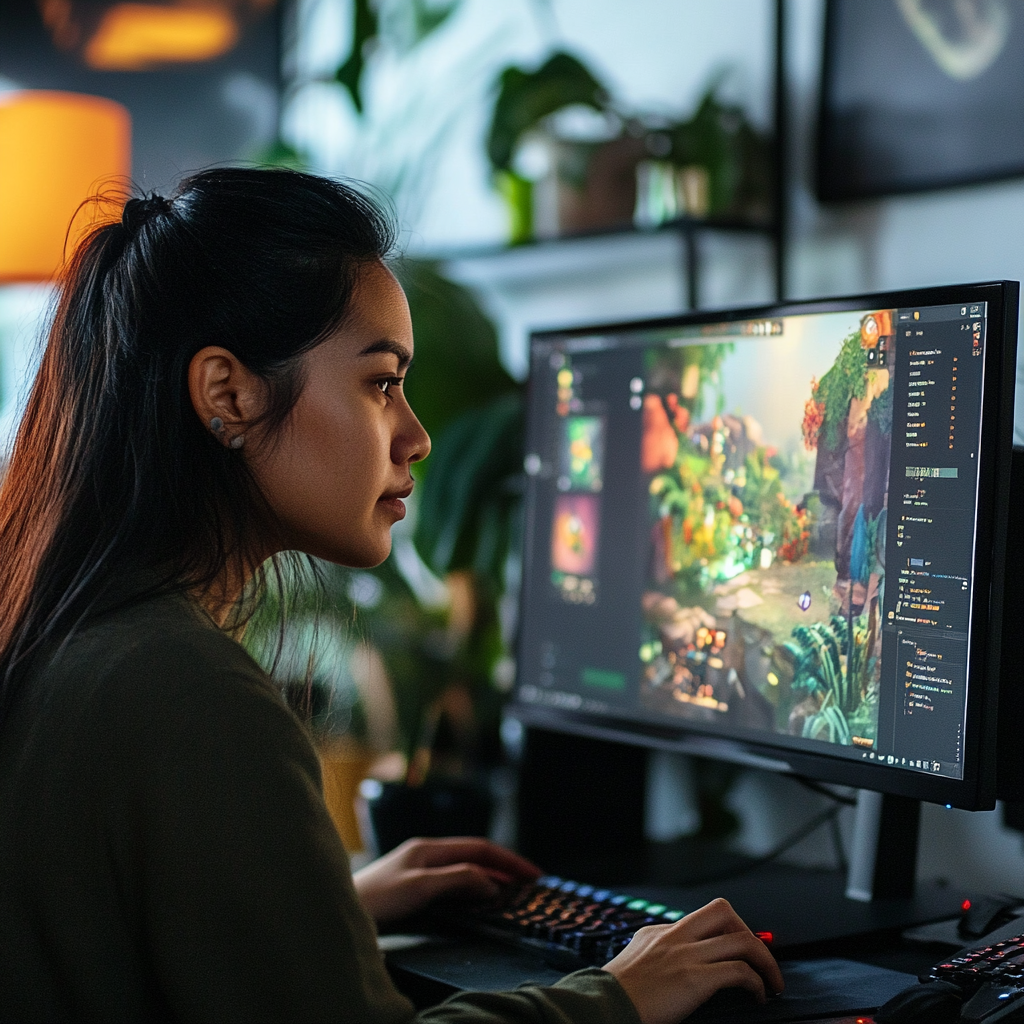
The impact of AI extends far beyond the screen, revolutionizing the game development pipeline itself. The mammoth task of creating assets—from 3D models and textures to animations and sound effects—is being accelerated by AI tools. Artists can use generative adversarial networks (GANs) to create high-resolution textures from simple sketches, or populate a forest with thousands of uniquely varied trees in minutes. This automation of labor-intensive tasks frees human developers to focus on high-level creative direction, intricate storytelling, and innovative gameplay mechanics.
Furthermore, AI is becoming a creative partner. Developers can use it to rapidly prototype level designs, generate concept art for new characters, or compose adaptive musical scores that shift seamlessly with gameplay. This lowers the barrier to entry for indie developers and allows large studios to tackle more ambitious, content-rich projects, potentially democratizing game creation and fostering a new wave of innovation.
Ethical Quests and Uncharted Dungeons: The Challenges Ahead
This powerful new toolset is not without its ethical and creative dilemmas. The reliance on AI-generated content risks homogenizing artistic expression if models are trained on narrow datasets. The “content ghost town” problem looms: will a world built entirely by AI feel meaningful, or will players sense the absence of human authorial intent?
Ethically, the use of AI to model player behavior raises significant privacy concerns. The data required for deep personalization is vast. Furthermore, as NPCs become more convincingly human-like, questions about appropriate interactions and the potential for emotional manipulation arise. The industry must navigate these uncharted waters with careful consideration and transparent ethics.
The Future: From Tools to Co-Creators
The trajectory is clear: AI is evolving from a behind-the-scenes tool for simulating behavior into a core, creative engine of game design. We are moving toward a future of “living games”—persistent worlds that evolve without patches, stories that are genuinely unique to each player, and challenges that learn and grow alongside us. The relationship between player and game is becoming a dialogue, a dance with an intelligent system.
The ultimate impact of artificial intelligence on video games is not merely about smarter enemies or bigger worlds. It is about fundamentally redefining the contract of play. It promises to transform games from static, authored experiences into dynamic, responsive universes—a shift as profound as the jump from text adventures to 3D graphics. In this new era, the player is no longer just following a script; they are collaborating with an invisible, intelligent puppeteer to author their own legendary tale within a world that breathes, adapts, and remembers. The game is learning to play us, just as we have always played it.