

The term “revolution” is often overused in technology, but for quantum computing, it feels almost insufficient. We are not merely witnessing an incremental improvement in processing power; we are peering into a fundamental rewriting of the rules of computation itself. Moving from the binary certainty of classical bits (0 or 1) to the probabilistic, parallel universe of quantum bits (qubits) that can be 0, 1, or both simultaneously (superposition), unlocks a paradigm shift. The question is no longer if there will be a quantum revolution, but how profound and far-reaching its effects will be across science, industry, and our understanding of reality.
The First Footholds: From NISQ to Quantum Advantage
Today, we reside in the era of NISQ (Noisy Intermediate-Scale Quantum) devices. These machines, with dozens to hundreds of qubits, are fragile, error-prone, and require near-absolute-zero temperatures. Yet, they have already achieved milestones. Google’s 2019 demonstration of “quantum supremacy” — where Sycamore performed a specific calculation far faster than any classical supercomputer could — was a symbolic proof of principle. More practical “quantum advantage” is now being sought in niche areas: optimizing complex logistics, simulating small molecules for drug discovery, and modeling novel materials.
This initial phase gives us a glimpse of the trajectory. Quantum computing will not replace your laptop; it will be a specialized tool, likely accessed via the cloud, for tackling problems that are exponentially intractable for classical machines. Its first major revolutions will likely be silent, happening in research labs and corporate R&D departments: designing a more efficient catalyst for carbon capture, unraveling the mysteries of high-temperature superconductivity, or formulating a new protein-targeting drug for neurodegenerative diseases. The impact here is monumental but indirect, solving foundational problems that have bottlenecked human progress for decades.
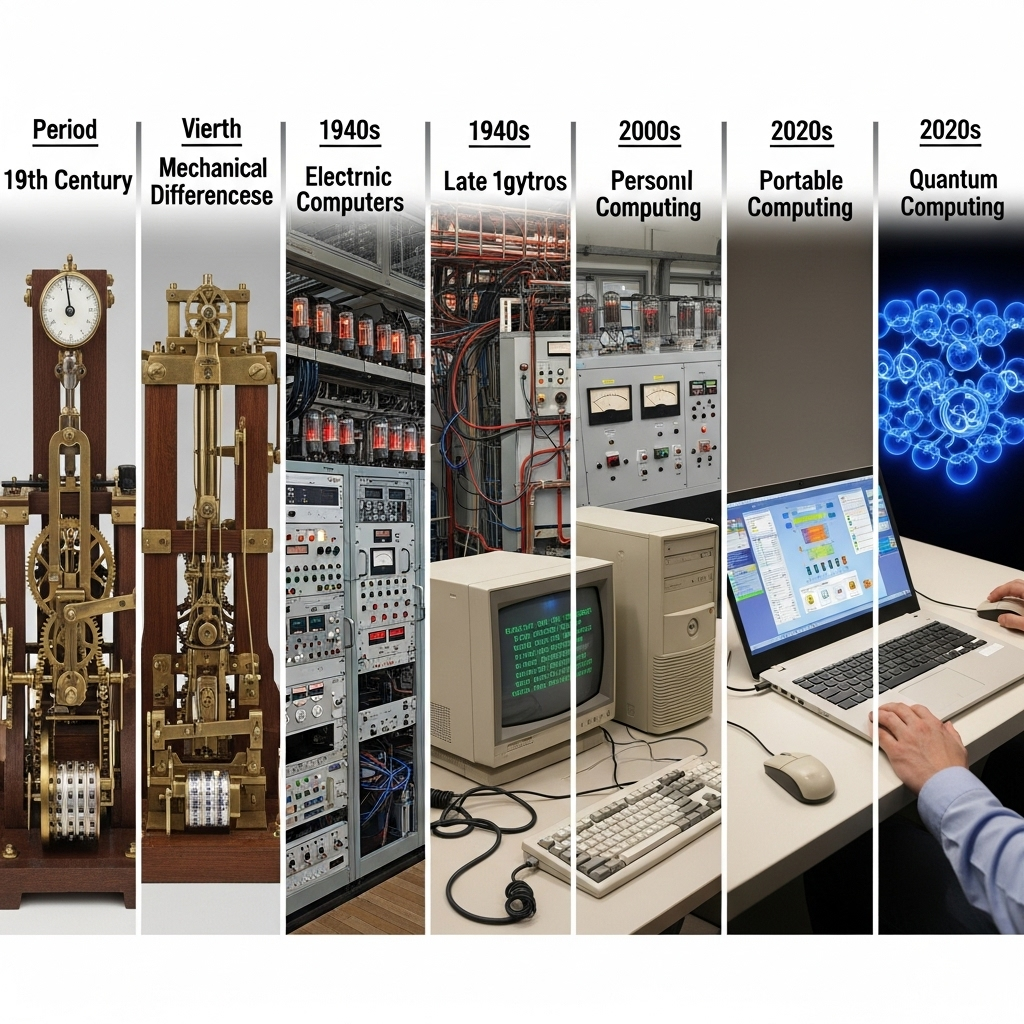
The Horizon of Fault-Tolerance: The Revolution Accelerates
The true inflection point will arrive with fault-tolerant quantum computing. This involves building systems with thousands of high-fidelity logical qubits, protected by quantum error correction, that can run extensive, complex algorithms without succumbing to noise. This is the engineering Everest of the field, potentially decades away, but its attainment will unlock the full theoretical promise.
At this stage, we can expect transformative breakthroughs:
- Chemistry and Materials Science Unbound: We will move from simulating simple molecules to modeling the nitrogen-fixing process of bacteria (revolutionizing fertilizer production) or designing room-temperature superconductors (enabling lossless power grids and levitating trains). This is perhaps the most certain and impactful destination—a mastery over matter itself.
- The Cryptography Paradigm Shift: Shor’s algorithm, run on a sufficiently powerful fault-tolerant quantum computer, could break widely used public-key encryption (like RSA). This looming threat is already driving the global shift to quantum-resistant cryptography. The revolution here is dual: it threatens existing digital security while forcing the creation of a new, potentially more robust framework for the quantum age.
- Exponential Optimization: Problems involving finding the best solution from a near-infinite set of possibilities—from global supply chain logistics and financial portfolio management to fundamental AI training processes—could be radically accelerated. This could reshape global markets and industrial efficiency.
The Speculative Frontier: Where Might It Lead?
Looking beyond these foreseeable applications, the revolution may venture into profound, even philosophical territory:
- Artificial Intelligence and Machine Learning: Quantum machine learning (QML) algorithms could identify patterns in high-dimensional data (like genomic or cosmological data) that are completely opaque to classical AI. This might lead to new forms of artificial general intelligence or unlock insights into complex systems like climate modeling or the human brain.
- Fundamental Physics: Could we use a quantum computer to simulate quantum gravity, to explore the conditions at the singularity of a black hole or the first moments after the Big Bang? It might become the ultimate laboratory for testing theories of everything, acting as a bridge between quantum mechanics and general relativity.
- The Nature of Computation and Reality: This is the deepest, most meta-revolution. As we build and program quantum computers, we are essentially harnessing the fundamental rules of the universe to perform computation. In doing so, we may confront deep questions: Are we discovering computation as a latent feature of physical reality? Could advanced quantum simulations become so complex that they raise questions about their own “reality”? The tool may eventually force us to re-evaluate the relationship between information, computation, and the fabric of spacetime.

The Limits and the Journey
However, this revolution will have boundaries. Quantum computers are not universally faster; they offer dramatic speedups only for specific, structured problems with exponential scaling. They will work in symphony with classical computers, which will handle control, correction, and pre- and post-processing. Significant hurdles remain: scaling qubit counts while maintaining coherence, developing viable error correction, and creating accessible software and algorithms.
Furthermore, the revolution will be tempered by human factors: ethical considerations (who controls such power?), economic divides (the “quantum divide” between nations and corporations), and security risks. The development of quantum computing is also a global race with immense strategic implications.
So, how far will it go? The quantum computing revolution will permeate in layers. In the short term, it will be a powerful, behind-the-scenes research accelerator. In the medium term, it will disrupt industries from pharmaceuticals to finance and redefine cybersecurity. In the long term, it may fundamentally alter our capabilities as a species, allowing us to engineer new forms of matter, probe the deepest secrets of the cosmos, and perhaps even challenge our understanding of what is possible to know and to compute.
The journey is akin to humanity’s first steps toward harnessing electricity. We started with simple sparks and Leyden jars (our NISQ devices), unable to foresee the coming grid, the internet, or the semiconductor. Quantum computing is our first glimpse into the “information electricity” of the quantum realm. We are just beginning to imagine what it will power. The revolution will go as far as our ingenuity, ethics, and perseverance can take us—potentially to the very limits of human knowledge and beyond.